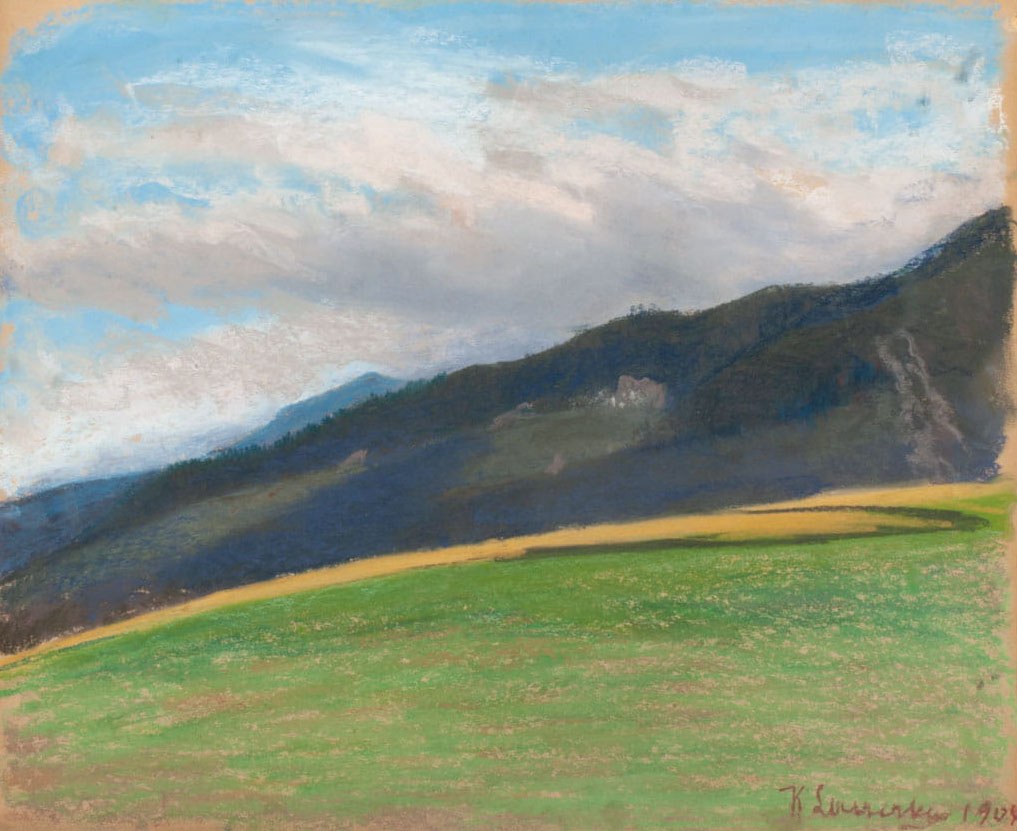
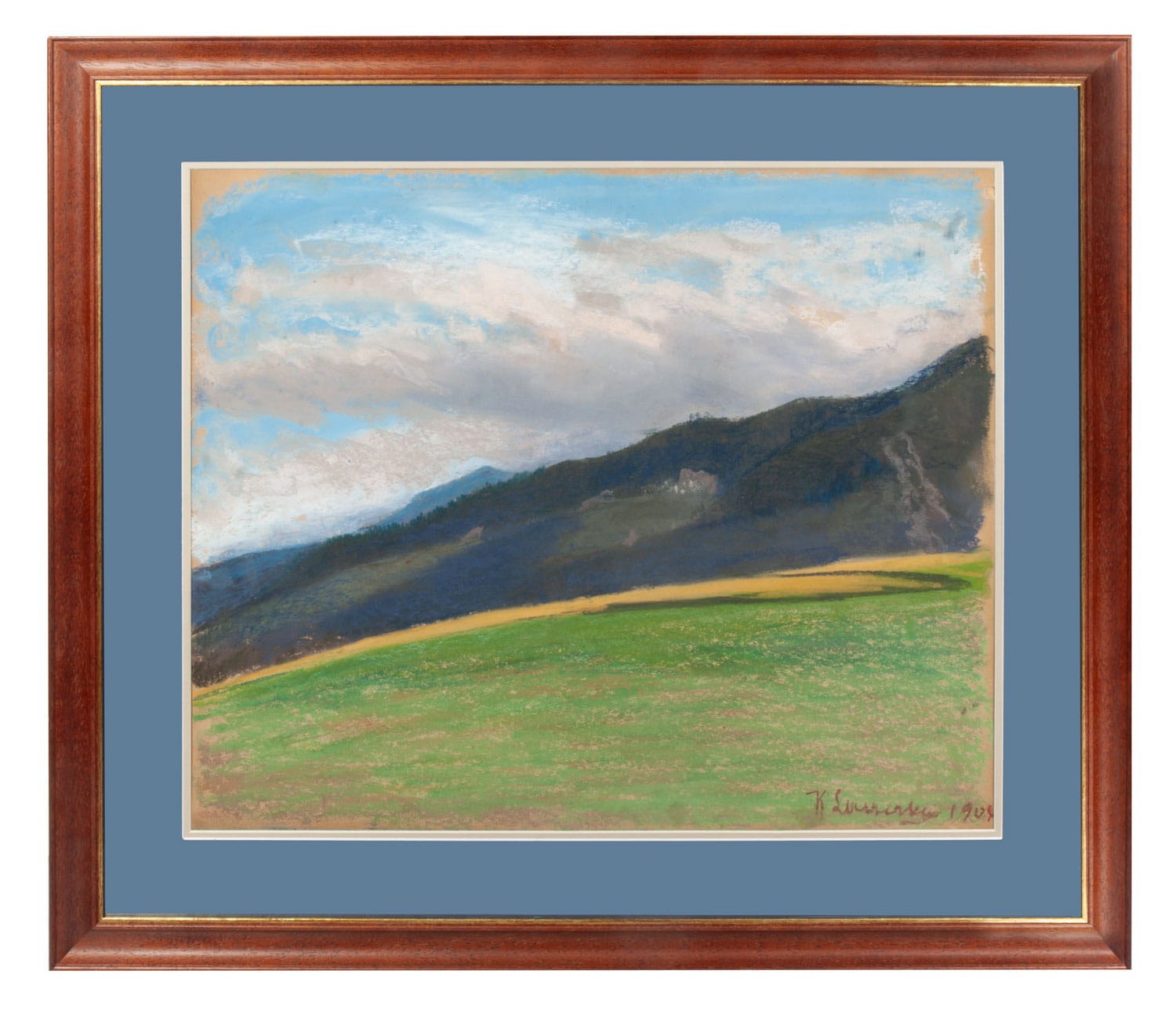
Pastel on cardboard, signed and dated lower right: “K. Laszczka 1905.”
Dimensions with frame: 71.5 × 81.5 cm (51 × 62 cm)
Exhibited and reproduced: - “Konstanty Laszczka 1865–1956,” Academy of Fine Arts in Kraków, November 2016–January 2017; [exhibition catalog] Zofia Weiss, Katarzyna Łomnicka, “Konstanty Laszczka,” Kraków 2017, p. 94.
“Konstanty Laszczka was among the artists inspired by the nature and culture of the Tatra Mountains and the Podhale region. Initially, like many others, he stayed in Poronin (where Kazimierz Przerwa-Tetmajer, Jan Kasprowicz, Władysław Orkan, Leopold Staff, and Leon Wyczółkowski also lived), and later at the Villa na Bystrem in Zakopane. Leon Wyczółkowski, meanwhile, during their joint mountain excursions around 1905, lived in the villa of the widow of Prof. Piotr Chmielowski.”
Konstanty Laszczka (Makówiec Duży 1865 – 1956 Kraków) – Polish sculptor, painter, printmaker, professor, and rector of the Academy of Fine Arts in Kraków. He came from a large peasant family in Mazovia. He was self-taught in the visual arts. The accidental discovery of his talent by the Ostrowski landowning family led to him being given the opportunity in 1885 to study in Warsaw under the guidance of Jan Kryński and Ludwik Pyrowicz. Later, he received a scholarship from the Society for the Encouragement of Fine Arts, which enabled him to travel to Paris in 1891. In France, he was a student at the Académie Julian and the École des Beaux-Arts. He studied under Antoine Mercié, Alexandre Falguière, and Jean-Léon Gérôme. He was also involved in the artistic movement of the Polish community in France. He ran a modest studio. In 1897, he returned to Poland and became a teacher in Warsaw. In 1899, at the invitation of Julian Fałat, he settled in Kraków, where he served as head of the sculpture department from 1900 to 1935 and, beginning in 1905, as a full professor at the Academy of Fine Arts. In 1911, he was appointed rector of the Academy of Fine Arts in Kraków. In 1917, he admitted Zofia Baltarowicz-Dzielińska, the first female student in the academy’s history, to his studio. He was a member of the Citizens’ Committee of the Polish Military Treasury in August 1914. He was friends with Stanisław Wyspiański and Leon Wyczółkowski. He was one of the founders of the “Sztuka” Society of Polish Artists. His students included, among others: Bolesław Biegas, Xawery Dunikowski, Ludwik Konarzewski, Franciszek Mączyński, Ignacy Zelek, Olga Niewska, Ludwik Puget, Stefan Policiński, and Balbina Świtycz-Widacka.