


oil, plywood, 71 × 49 cm
signed l. d.: B. Biegas
on the back two paper stickers: 1) 422/Leda/1919 (handwritten); 2) 1927 APM109/Léda/422 0.70 xo, 48; 3) tag with handwritten number 27
Provenance:
Private collection, Poland
Exhibited:
- "Bolesław Biegas - painting and sculpture," Mazovian Museum in Plock, 15
May 2011 - December 31, 2019.
Reproduced:
- "Bolesław Biegas 1877-1954," Mazovian Museum in Plock 1997, p. 123 (il.).
- Xavier Deryng "Bolesław Biegas," Polish Historical and Literary Society in Paris, Polish Library in Paris, 2011, p. 272
"In the majestic beauty of the night sky, a vast wall of dark blue enamel dotted with muted stars or the evening sky whose blue deepens in waves, devoid of matter in this waning brightness, under a sky colored by the fire of the setting sun and as if ornamented by the extraordinary departure of great birds of purple, emeralds, sapphires - a rock, an island of meditation planted with tall cypresses and castles of dreamy dreams. An enchanted castle, a castle of moonlight, a castle of Atlantis flowering the sea with its sudden bloom, a castle of kings and queens, Biegas' imagination builds them from human shapes, frozen in solemn ecstasy, melancholy kings, hopelessly in love virgins.
Gustave Kahn, "Boleslas Biegas. Les Nuits Mystiques," [in:] Exposition des Ouvres de Charles Hetherington le Célèbre Peintre Américain et de Boleslas Biegas Peintre Polonais, Paris, Galerie André
Seligmann 1925, pp. 12-14
At the beginning of the 1920s, Boleslaw Biegas painted a whole series of paintings with an oneiric and symbolic meaning entitled "Mystique of Infinity." This was a kind of homage to Arnold Böcklin and his famous Island of the Dead, which became a huge inspiration for Biegas. Compositions from this series are scenes maintained in a mystical, almost theatrical atmosphere of nocturnes, shrouded in dark black and dark blue, with a peculiar depiction of figures in a bright glow contrasting to the background.
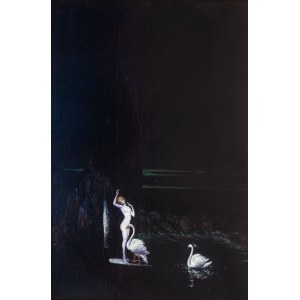
The painting "Leda" presented in the catalog is an excellent example of a scene from this series. Here Biegas used the motif of the mythological figure of Leda, queen of Sprata, mistress of Zeus, who seduced her in the form of a swan. He depicted the composition in a gloomy setting characteristic of the series.
Beneath a towering soaring cypress tree in the shadows, one can see the figure of a young blonde woman glowing silvery. Her slender, almost columnar figure is shown slightly bent in a sensually erotic pose with her arms stretched upward as if in ecstasy. By her side stands a white swan, with its head resting on her bosom. A second swan swims up to the couple, its silhouette reflected in the slightly murmured water.










Senast sedda
Vänligen logga in för att se objektlistan
Favoriter
Vänligen logga in för att se objektlistan