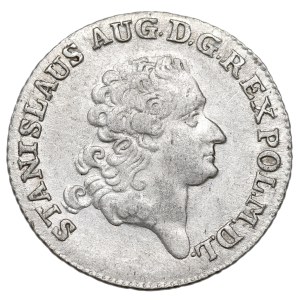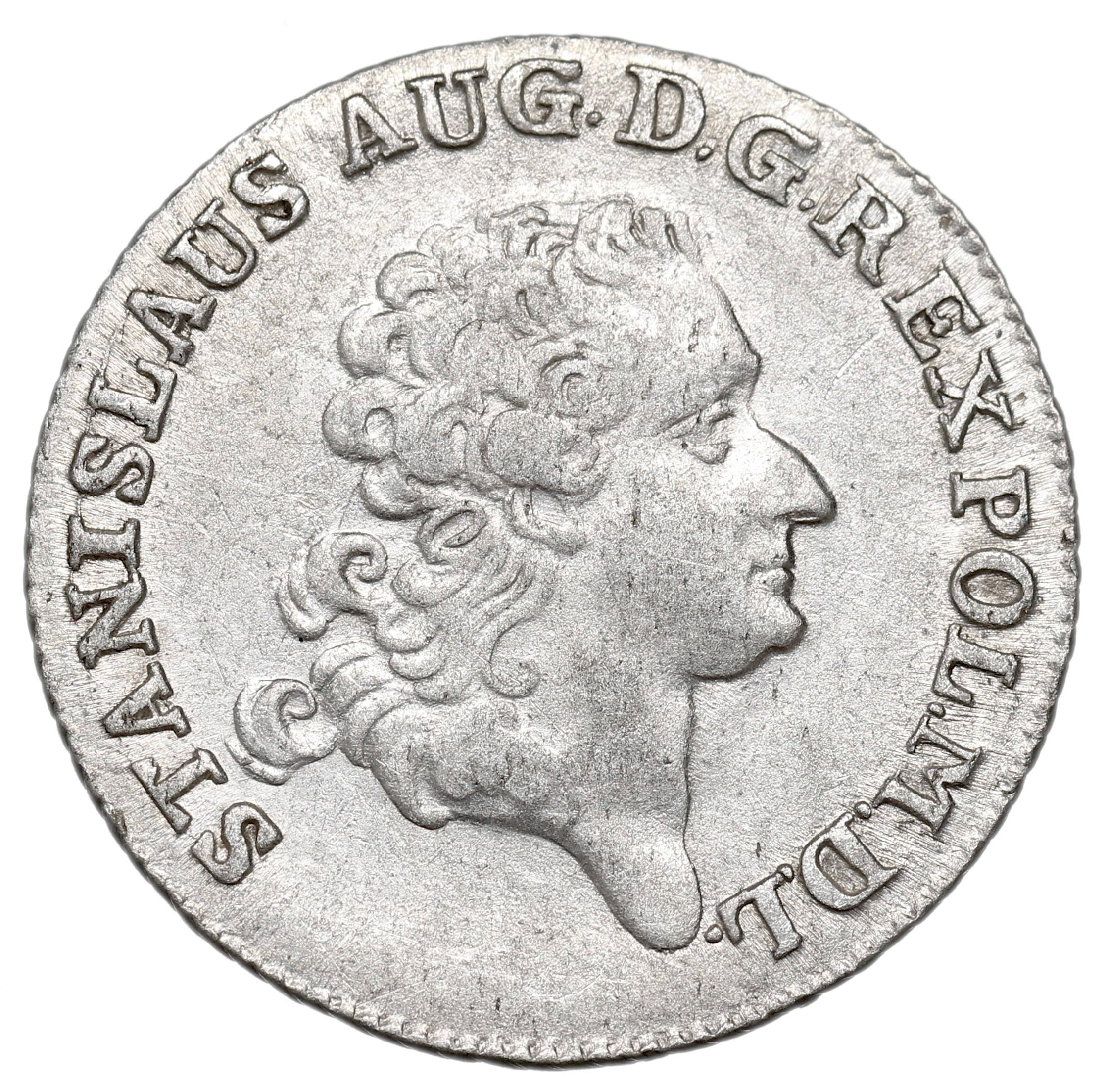
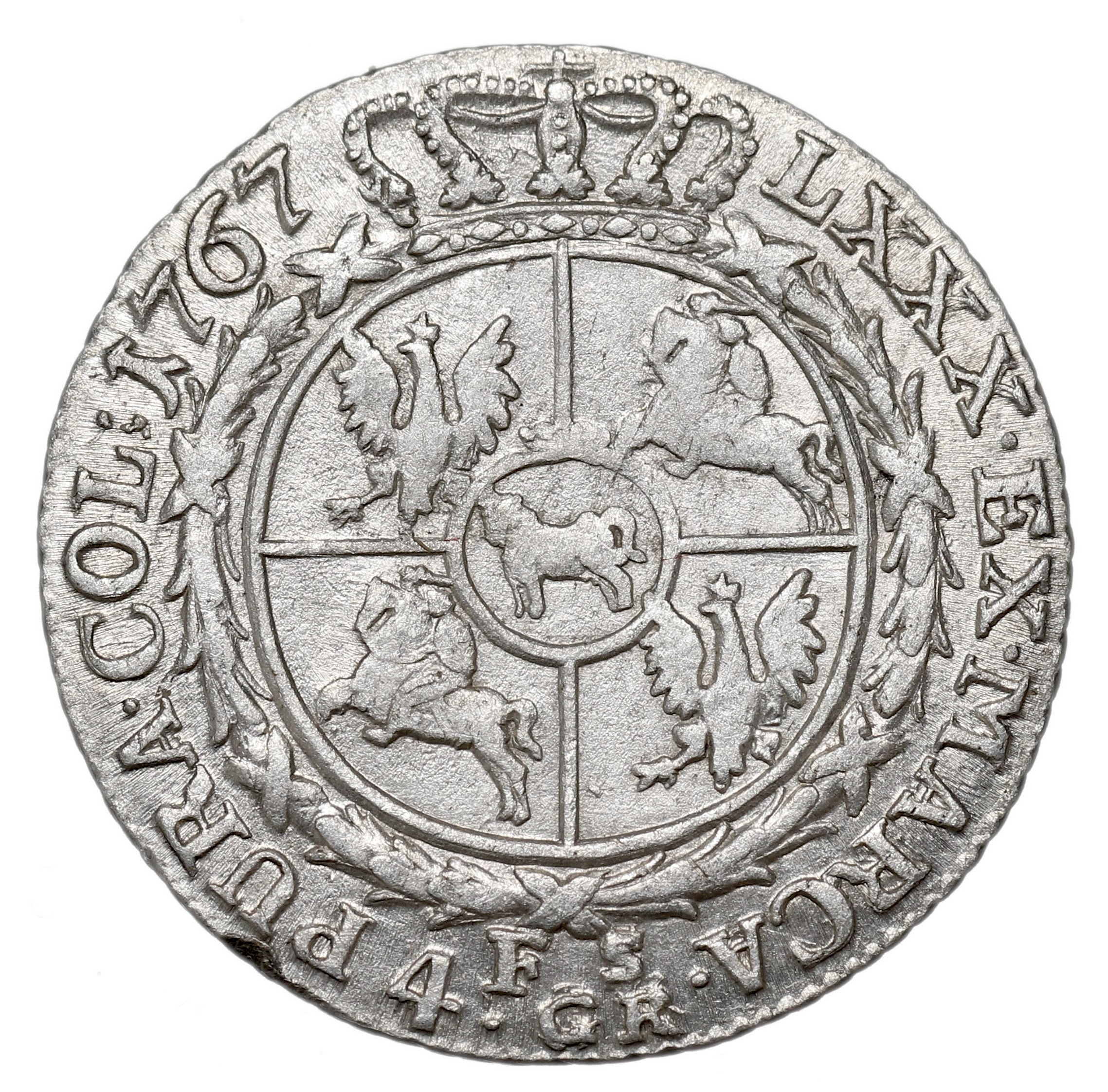
Very poor Prussian silver. A sheen in the background.
The coin, struck in low-quality silver, first appeared in circulation in Poland in Greater Poland on October 15, 1770. According to Friedrich von Schrőter, the counterfeiting of złoty coins continued until 1772, a fact also confirmed by E. Bannicke. Thus, we are dealing with a production period of only two years. Coins that were not detected remained in circulation, as evidenced by the relatively large number of pieces of these coins in circulated condition known from the auction market.
Obverse: head facing right, with the legend around the edge:
STANISLAUS AUG.D.G.REX POL.M.D.L.;
Reverse: a crowned five-field coat-of-arms shield bearing the coats of arms of the Crown, the Grand Duchy of Lithuania, and the Poniatowski family of Ciołek, within a laurel wreath. Below are the initials of Fryderyk Sylma—FS—and the denomination 4.GR., with the following legend along the rim:
LXXX•EX•MARCA-PURA•COL:1767•;
This coin serves as an extraordinary testament to the era marking the decline of the Polish-Lithuanian Commonwealth’s glory, and stands as evidence of the destruction of the national economy by its Prussian neighbor, which had risen to power thanks to the mistakes of the Polish nobility.