


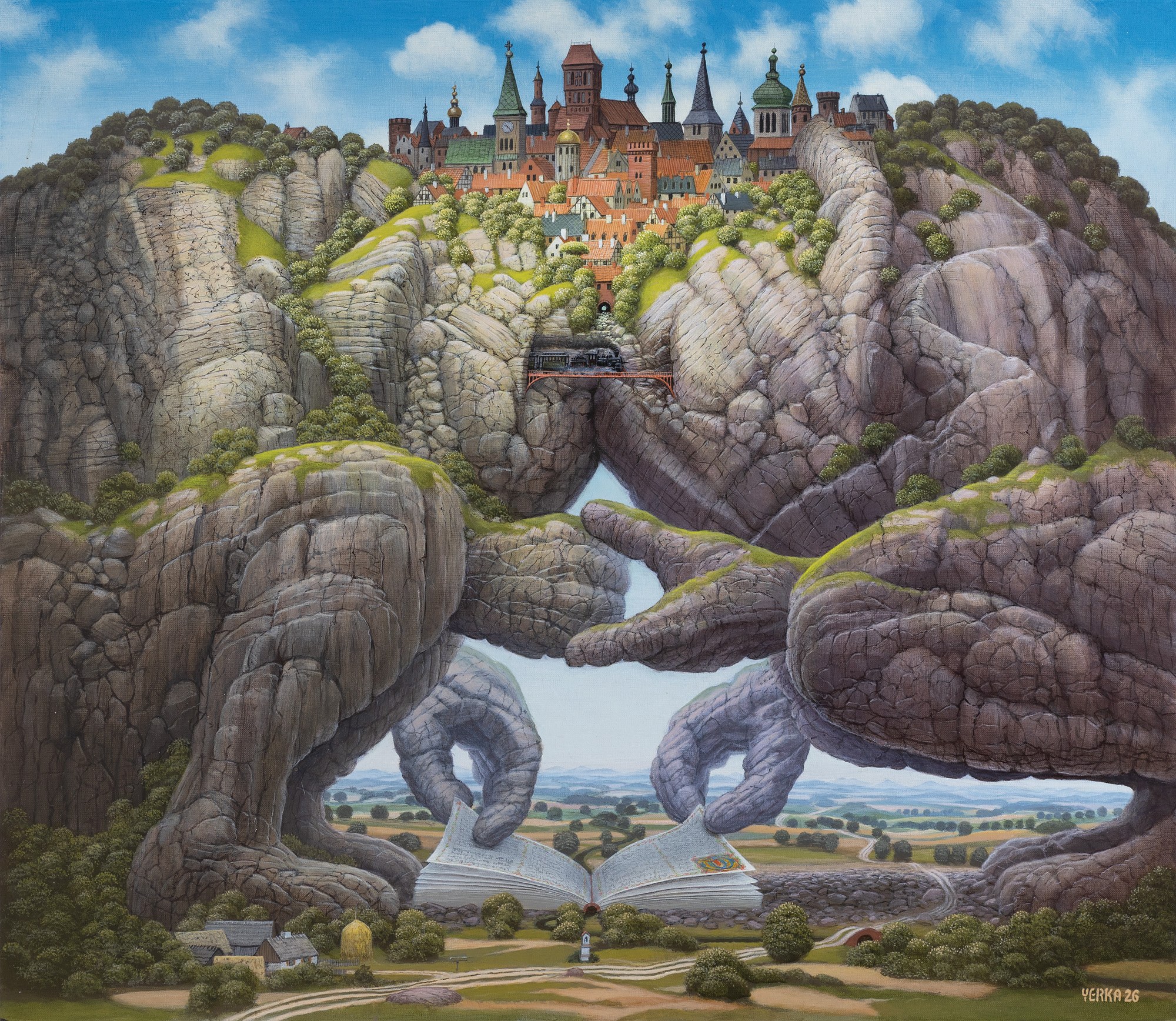
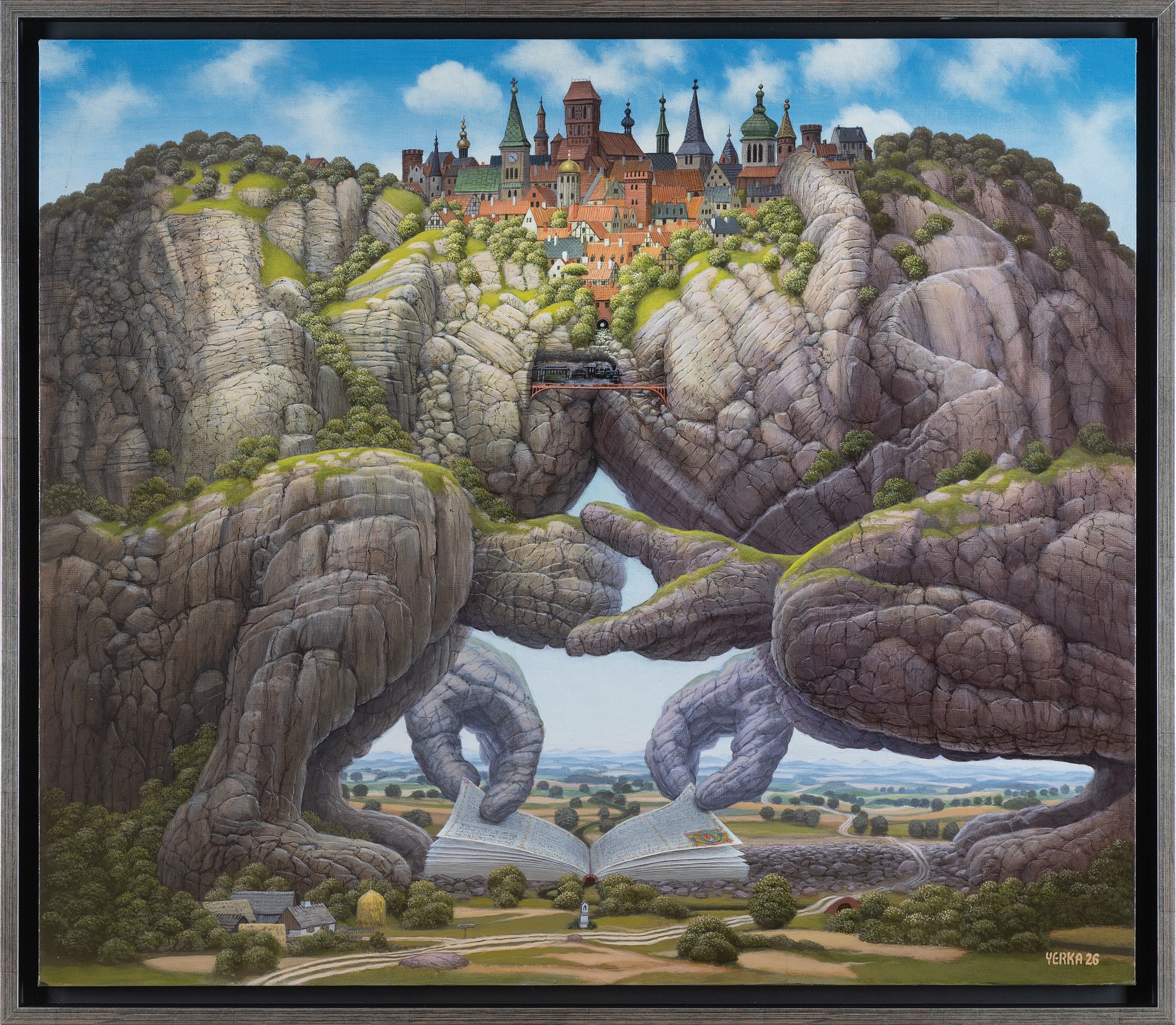
70 x 81.5 cm - acrylic on canvas
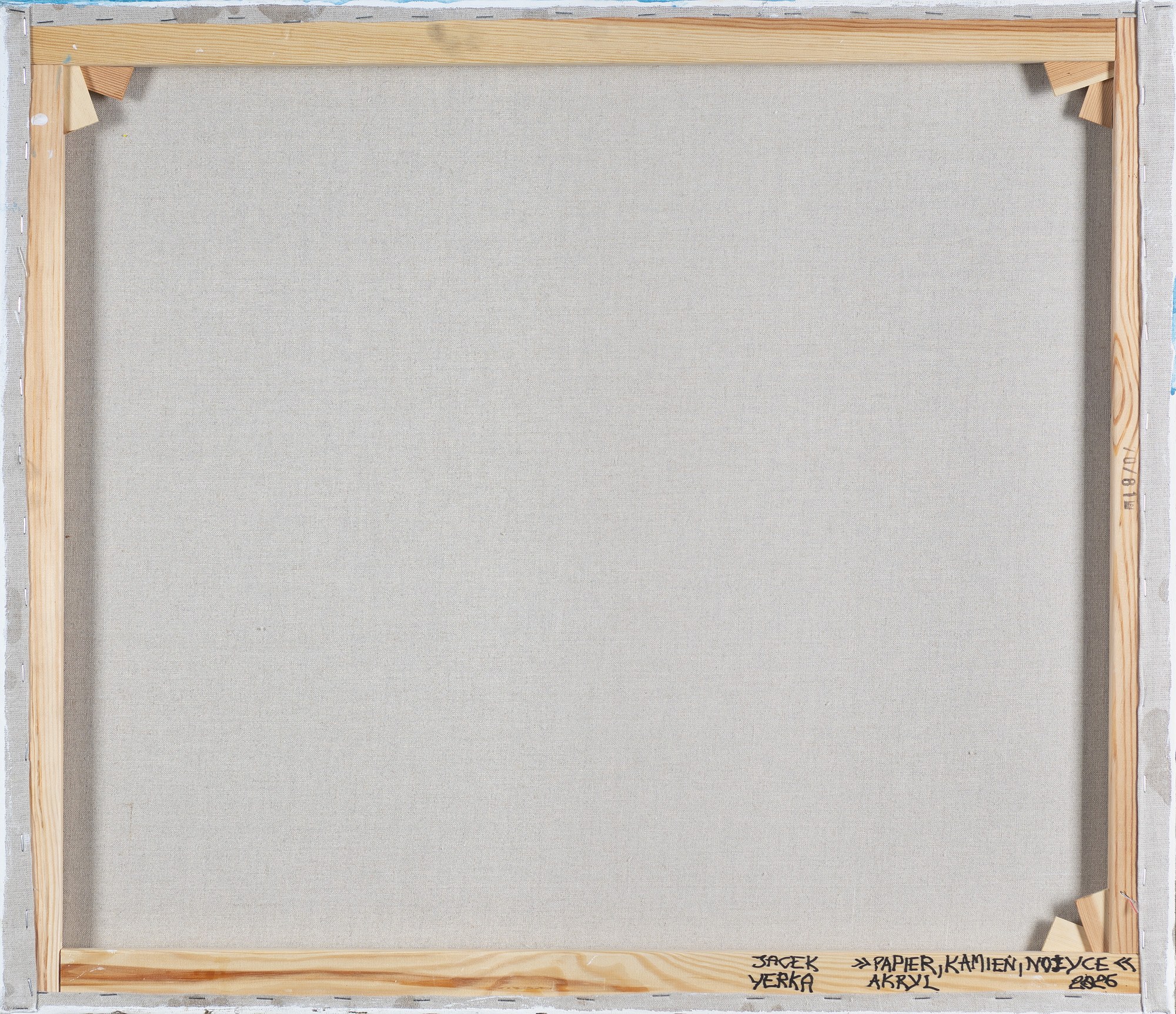
signed: YERKA 26
signed on the reverse with a marker on the bottom bar of the stretcher: JACEK | YERKA
next to it: >>PAPER, STONE, SCISSORS<< | ACRYLIC 2026
Jacek Yerka:
The spark, the catalyst for painting this work, was a media report about a politician who was unable to play the eponymous game on a TV show.
I thought it would be a painting about people who have exceeded the limits of their competence and are no longer able to make even the simplest decision on their own.
Two ancient, severely eroded trolls decided hundreds of years ago to play rock, paper, scissors (or perhaps someone maliciously persuaded them to do so) and became completely confused and stuck in a loop, trying to make a quick move to outmaneuver their opponent.
Fearing they might make the wrong choice, they became stuck in a rocky stalemate for all eternity.
Entrepreneurial humanity seized them and exploited them for its own purposes.
I have no idea where they dug up that priceless incunabulum in in-plano-plus format; our culture certainly didn’t produce it, that’s for sure.
It was probably planted here along with the trolls and politicians by some extraterrestrial civilization during its last visit to Earth.
That’s the only way to explain why everything looks the way it does.
Jacek Yerka (born in Toruń in 1952, lives in Bory Tucholskie) graduated in 1976 from the Faculty of Fine Arts at Nicolaus Copernicus University in Toruń.
He specialized in graphic arts. During his studies, he participated in numerous competitions focused on poster art, including those marking the 50th anniversary of the Polish Hunting Association (1st prize), the so-called “Festival of Rebirth” (1st prize), the Olympic Games in Toronto, the 50th anniversary of LOT, and those promoting “Społem.”
Shortly after graduating, he won third prize at the Polish Poster Biennial in Katowice (1979). During this time, he also made a name for himself on the international scene. In 1978, he won a competition titled “Palestine—homeland denied,” organized by the Iraqi Cultural Center in London, and a year later, he won a competition for a poster promoting the development of public transportation in Milan.
His works were exhibited at the International Sports Biennial in Barcelona (1980, third prize), the International Poster Biennial in Warsaw (1981, third prize), and the Poster Biennial in Lahti (1983, third prize). In the early period of his career, the artist rarely created paintings, including entries for the Jan Spychalski Painting Competition in Poznań (third prize twice). After 1980, he abandoned poster art and devoted himself entirely to painting. Drawing on a precise painting technique modeled after the old masters (Jan van Eyck, Hieronymus Bosch), but above all on his own boundless imagination, he creates surreal compositions, particularly admired by fans of fantasy in all its forms. He inspired, among others, fantasy author Harlan Ellison to write 30 short stories, which, together with the artist’s paintings, formed the collection *Mind Fields*, winner of the 1995 World Fantasy Award. The album’s success led to an exhibition at the Morpheus Gallery in Beverly Hills in 1998. The same publisher—“Morpheus International”—released the album *The Fantastic Art of Jacek Yerka*. The artist also collaborated on the production of the American film *Strawberry Fields*, in which his artwork was to be accompanied by music by The Beatles. The artist’s works—as a highly regarded representative of the fantasy genre—are found in many private collections in Poland and abroad. Jacek Yerka’s exhibitions have taken place abroad (including at the Hela Nebelung Galerie in Düsseldorf in 1983) and in Poland—at the OdNowa Gallery in Poznań (1975), the Grażyna Hase Gallery in Warsaw (1980, 1982), the Alicja and Bożena Wahl Art Gallery (1990), the Filmar Hotel in Toruń (2016), and DA Agra-Art (2022).
Jacek Yerka, An Artist’s Life
My artistic career began during my second year of studies at the Faculty of Fine Arts at Nicolaus Copernicus University. Completely unexpectedly (for myself, my classmates, and the faculty), I won a poster competition marking the 50th anniversary of the Polish Hunting Association. I received first prize in the amount of 450 zł, with which I bought a large album of Bosch’s works and an even larger one of Dürer’s prints at the KMPiK bookstore.
In my third year of college, I entered a poster competition to mark the so-called “Festival of Rebirth,” which I again unexpectedly won. This time the prize was more substantial, and Gen. Jerzy Ziętek personally congratulated me on my success in Katowice. I was slowly turning into a prize hunter. I entered every possible poster contest—for May 1st, July 22nd, those advertising “Społem” (they paid the best and printed my highly realistic and technically challenging designs reasonably well), the Olympic Games in Toronto, for the 50th anniversary of LOT, for the knights’ tournament at Golub Castle (here the organizer promised me the prize and kept his word—I think I was the only participant in that memorable contest), and many others that I no longer remember in detail.
To avoid falling into a rut, I also took part in the Jan Spychalski painting competitions organized in Poznań; there, in the late 1970s, I won third prize twice. In 1978, I won a competition organized by the Iraqi Cultural Center in London under the theme “Palestine—homeland denied.” I received £1,500 (1£ was worth 3.5 $), an enjoyable trip through Iraq, and a handshake from Tariq Aziz (it was supposed to be Saddam Hussein, but he was in the midst of purges within the Ba’ath Party).
I also won third prize at the Polish Poster Biennial in Katowice in 1979. In 1980, I received third prize at the International Sports Biennial in Barcelona. Also in 1980, I won a competition in Milan for a poster promoting the development of public transportation—I personally collected the prize, which was astronomically high by the standards of the time, driving a small Fiat with a cracked head gasket, slowing down more and more as I crossed the Alps. I also won third prize at the International Poster Biennial in Warsaw in 1981 and at the Poster Biennial in Lahti in 1983.
That marked the end of my adventure with poster art; painting had completely absorbed me. In 1995, my book *Mind Fields*, published in the U.S. by James Cowan in collaboration with Harlan Ellison, won the World Fantasy Award. This led to an exhibition in Los Angeles in 1998 at the Beverly Hills Gallery. In 2011(?), NVIDIA organized a global competition for computer graphics inspired by my paintings. I liked the winning entry so much that I created “The Third Day of Creation,” inspired by it. The history of my solo exhibitions is brief and stems from the nature of my work. The paintings are time-consuming to create, and most find buyers before the idea for the next exhibition even takes shape.
But I’ve managed to pull it off a few times:
At Jan Malik’s gallery in 1975 at the Od Nowa Gallery in Poznań—six large paintings, my entire body of work at the time—I carried them down the train aisle to Poznań, all the while making sure that the jostling passengers didn’t dent them; but at the opening, I had a great conversation with Prof. Tadeusz Brzozowski, who reinforced my conviction to paint in my own way and not worry about what others think;Grażyna Hase in 1980 and 1982, at her atmospheric gallery on Marszałkowska Street in Warsaw; Hella Nebelung in 1983 at the Hella Nebelung Gallery in Düsseldorf;Alicja Wahl in 1990 at her own gallery in Żoliborz; James Cowan in 1998 at the Beverly Hills Gallery in Los Angeles;Wiesia Żyla in the lobby of the “Filmar” Hotel in Toruń (giclée only) in 2016; Konrad Szukalski in 2012 at the Agraart Auction House gallery.I cannot forget the brass statue of Katarzyna in Toruń’s Walk of Fame in front of Artus Court, where I addressed a gathered crowd on a summer evening in 2008. I’m constantly painting and trying to tackle new ideas or dust off old ones that I was once unable to realize due to technical or mental limitations.













Senast sedda
Vänligen logga in för att se objektlistan
Favoriter
Vänligen logga in för att se objektlistan