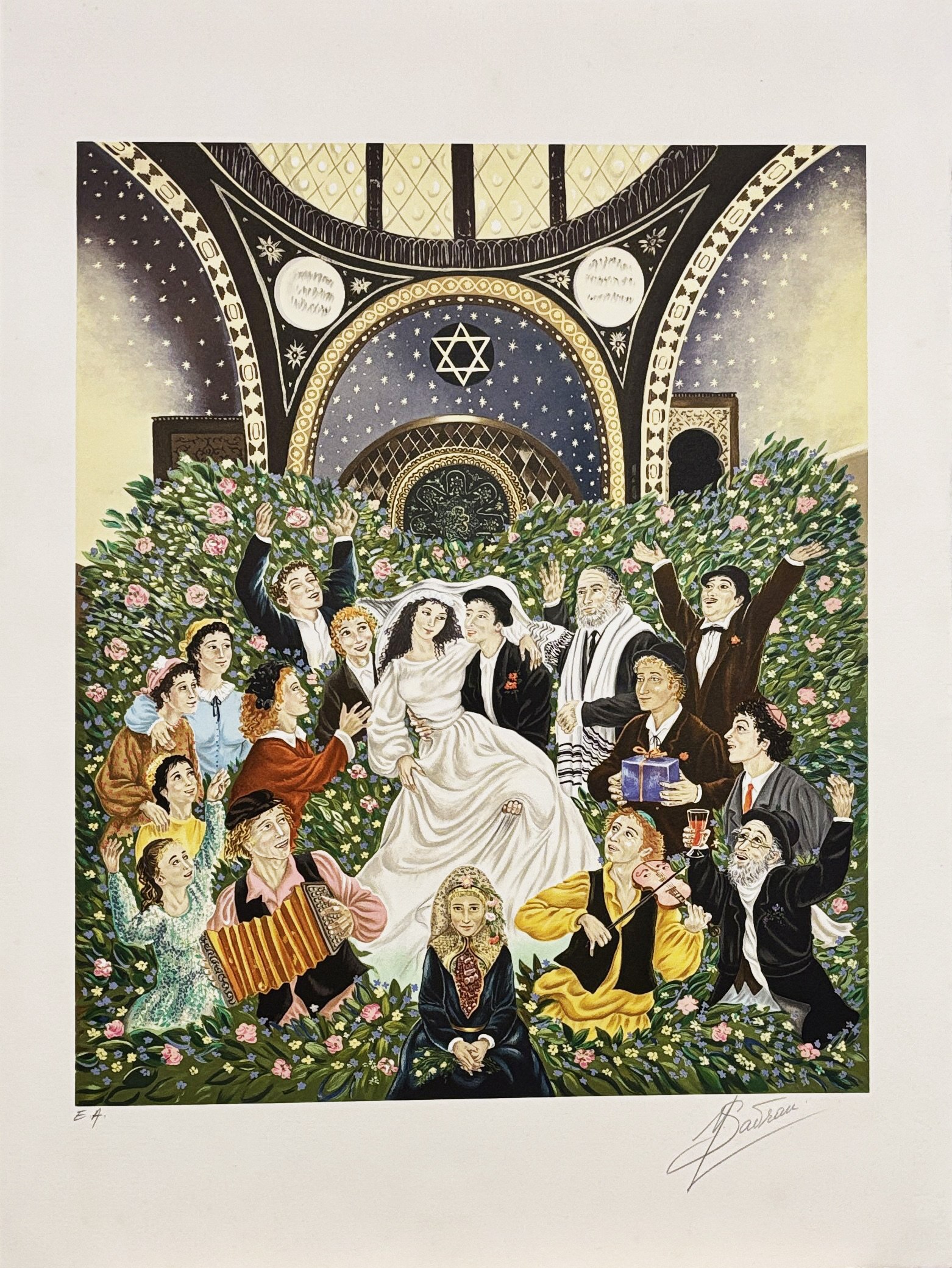
Color lithograph on Arches Paris paper (watermark), 56 x 46 cm (composition), edition limited to 250 pieces and a few with E.A. markings, signed in pencil by the artist l.d.
Publisher: Vision Nouvelle (French publisher, which at the time was releasing series of lithographs by many well-known artists for the US and Israeli markets).
The author's prints (E.A.) are pieces intended for the artist herself - they served her as archives, for exhibition purposes or as gifts for relatives and associates. They usually make up about 10% of the total print run.
Sandra Frigoli is one of those artists who are very careful about their privacy - auction catalogs and biographical notes rarely give her exact daily date of birth, focusing instead on her output over the past few decades.
She studied in Paris (including at the École des Beaux-Arts), which had a key influence on her printmaking technique. It was there that she perfected the technique of lithography, which was used to make "Jewish Wedding."
The greatest artistic activity and increased interest in her works came in the 1970s, 1980s and 1990s. It was then that her lithographs became popular in galleries specializing in Judaism (especially in Paris, Tel Aviv and New York).
As someone born in 1940, she created at a time when a return to traditional, "naïve" and warm motifs (such as weddings and shtetl life) was a form of artistic cultivation of the memory of a world that had undergone great changes.
Her style is often compared to the aesthetics of Marc Chagall, although Frigoli retains her own more "earthy" and joyful line, less dreamlike than that of the master from Vitebsk. Frigoli's works allude to the naive style and expressionism. Her work is firmly rooted in figurative subject matter - she rarely escapes into abstraction, preferring to tell concrete stories through figures and their emotions. Her works are characterized by soft lines, a rich color palette (often warm, earthy or deep blues) and great attention to the details of costumes and backgrounds.
This artist's works regularly appear in auction houses, especially in France and Italy. They are prized by collectors of Judaic art and lovers of naive painting for their "soul" and decorativeness.
The frames shown in the visualizations are for illustrative purposes and do not constitute a commercial offer.