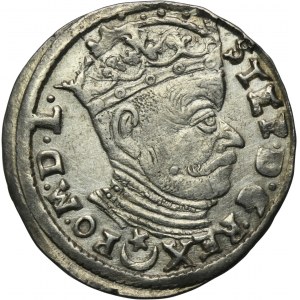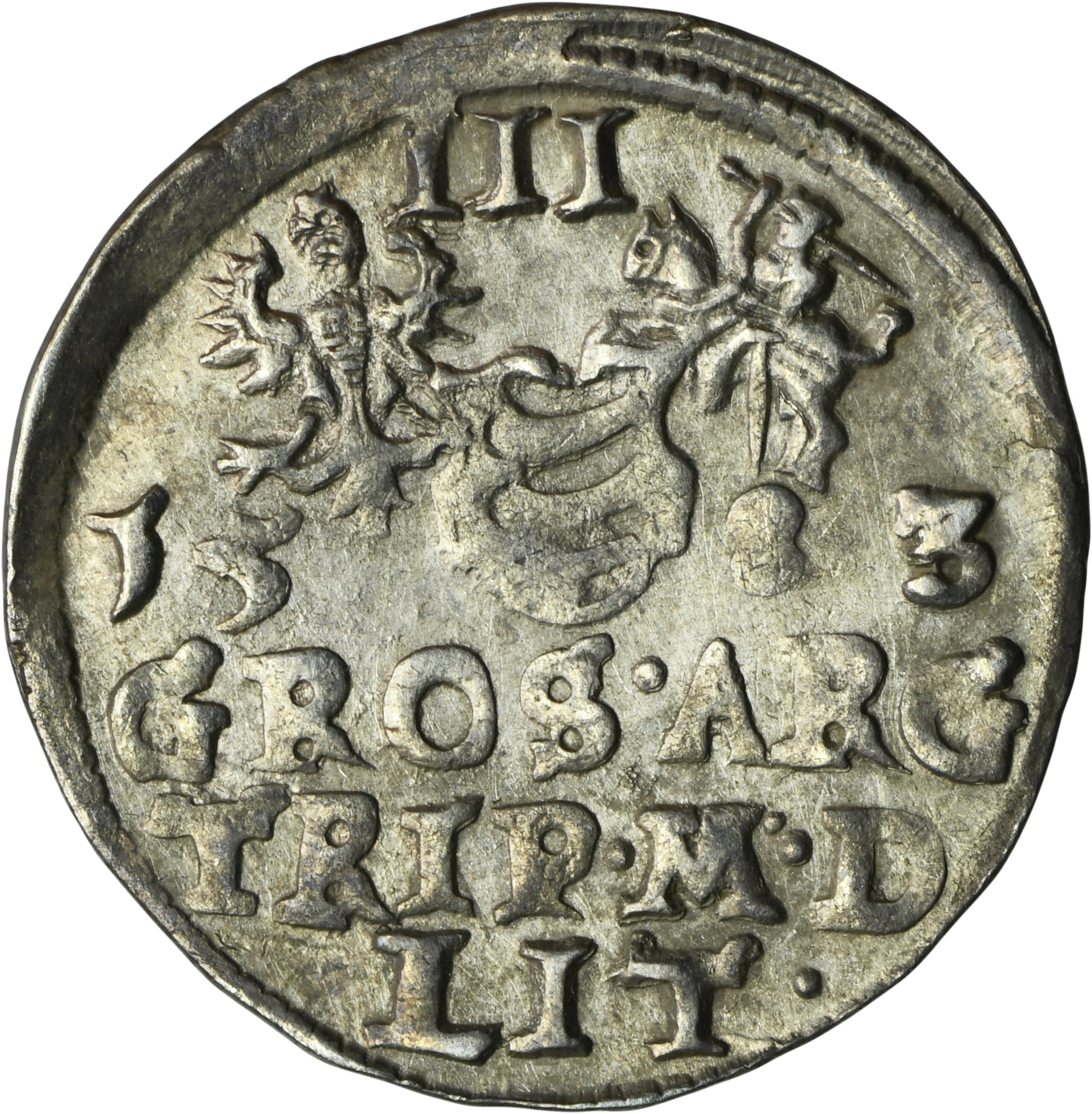
Variety with the Leliwa coat of arms of Jan Hlebowicz under the bust of the king, dot after STEP.
Glossy art. Background rubbed.
After the great monetary reform of Sigismund the Old, there was a decades-long period of stagnation, which over time turned into monetary chaos. At the threshold of Stefan Batory's reign, coins of the last two Jagiellons were in circulation, as well as foreign coins. It was essential for the new king to put monetary issues in order. Stefan Batory's Great Reform of 1578-1580 is one of the most important in the history of Polish minting. It included, among other things: the issuance of stable and full-value money, the linking of the Republic's monetary system with the imperial system, and the final implementation of the Polish-Lithuanian monetary union. The system introduced in 1580 functioned until the end of Stefan Batory's reign and for much of his successor's reign (until 1601). During the reign of Stefan Batory, the following mints were in operation: crown mints (Olkusz, Poznan), Lithuanian mints (Vilnius), Prussian mints (Malbork), and municipal mints (Gdansk, Riga). In addition, Lithuanian two-dollars were issued by the Kurland mint in Mitava, while the king had crown thalers and ducats minted at the Transylvanian mint in Nagy Banya. Minting associated with the reign of Stefan Batory also includes Danzig siege coins from 1577.
During the reign of Stefan Batory, Polish trojaks became international money. Like Athenian tetradrachms in antiquity, Wenceslas II's pennies in the Middle Ages, or American dollars during the Polish People's Republic, Stefan Batory's trojaks were eagerly accepted abroad (Central and Eastern Europe, the Balkans, Turkey) and treated as "reliable money." Several reasons contributed to this. First and foremost, they were issued in large quantities and systematically, were minted from good silver (XIII ½ flotation), and additionally had an attractive appearance. The average weight of trojaks was 2.44 grams, of which pure silver accounted for 2.059 grams. On the obverse of crown trojaks was placed a royal portrait and an otolithic inscription. On the reverse, under the denomination "III" were the coats of arms of Poland, Lithuania and the Three Teeth of Batory at the top, the coat of arms of the treasurer at the bottom (with the date on its sides) and an inscription in three lines. In the initial issues (1579, 1580), before the iconographic scheme discussed above crystallized, the coats of arms of Poland and Lithuania were not placed on the trojak at all, while the coat of arms of Batory and the treasurer were located elsewhere. Crown trojaks were issued by the mints in Olkusz (1579-1586) and Poznan (1584-1586). A small series of Prussian trojaks (GROS ARGEN/ TRIP TERRA/ RVM PRVS) was minted at the Malbork mint in 1585. However, these coins did not enter circulation, so they can be regarded as trial issues. Lithuanian trojaks were minted by the Vilnius mint in 1580-1586, while the Gdansk mint only issued trojaks in 1579. Instead of the coats of arms of Poland and Lithuania, of course, the coat of arms of Gdansk was placed on the reverse. Gold prints made with the stamps of Danzig trojaks are also known. However, these are probably "works" of 19th-century collectors with original stamps. City trojaks from the mint in Riga were issued between 1581 and 1586, with the medium coat of arms of Riga being put in place of the Polish eagle and the Pogo. A variety from 1581 is known, where the reverse featured the coats of arms of Poland and Lithuania and the small coat of arms of Riga.