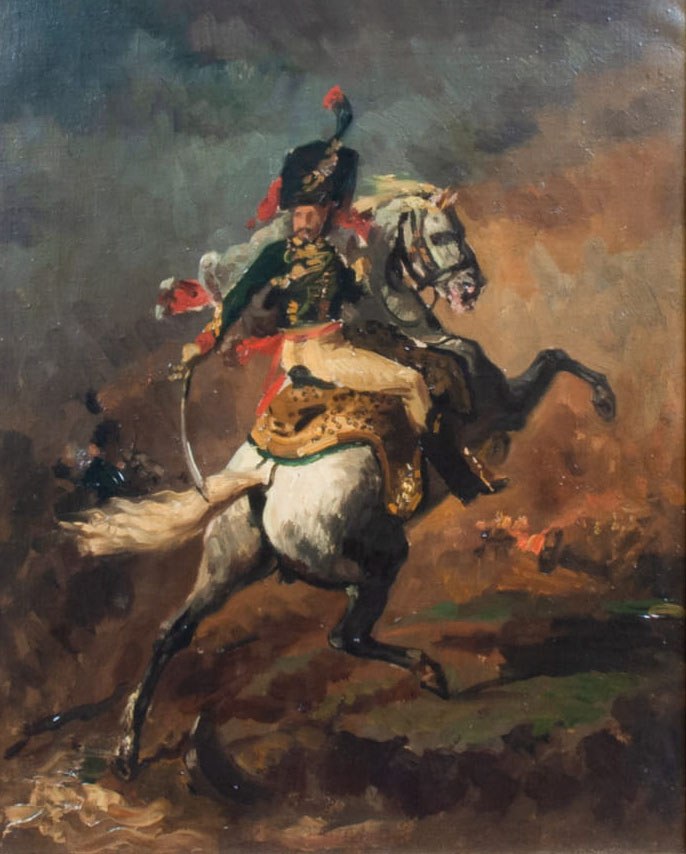
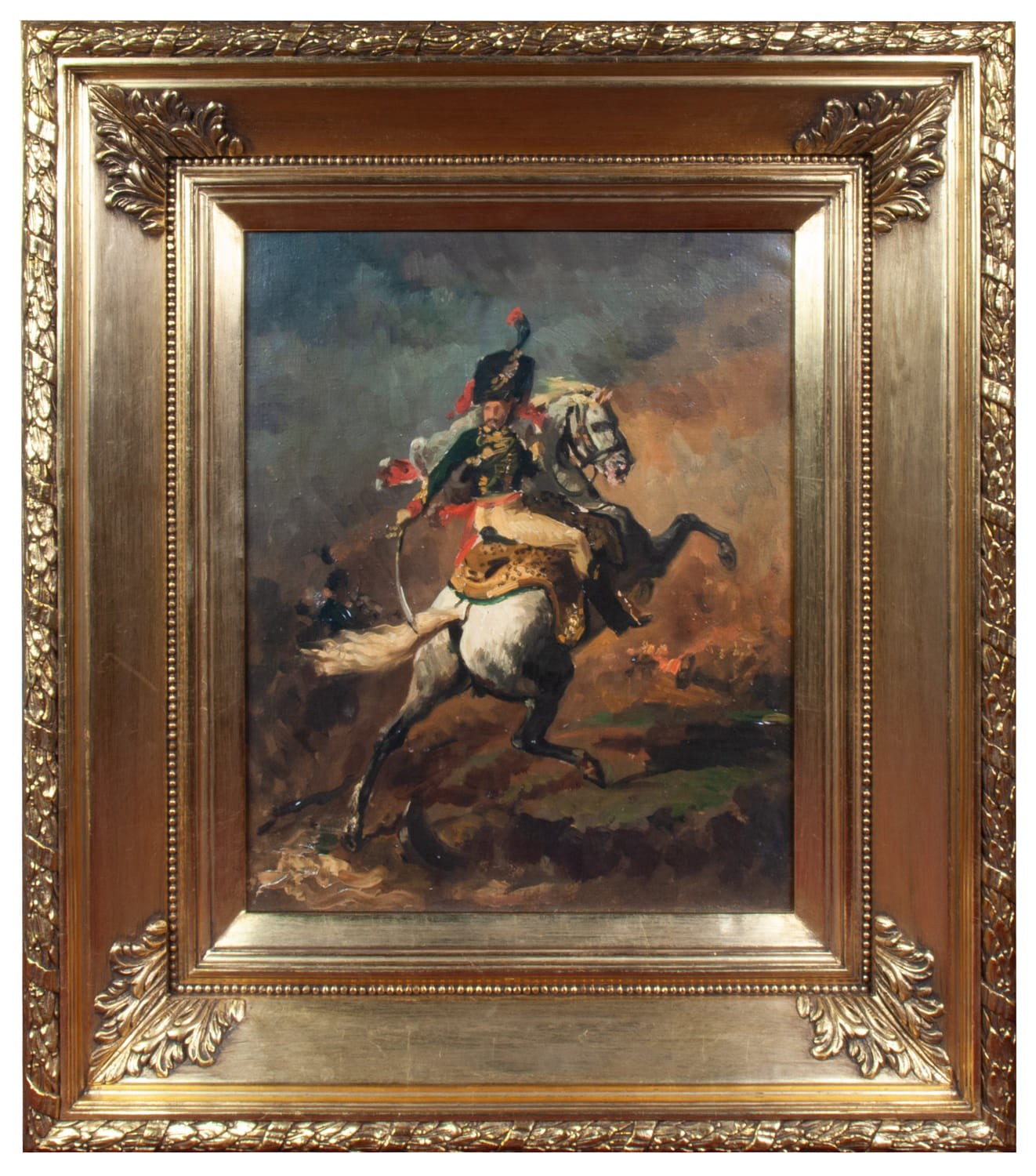
Oil on canvas. On the reverse the partially preserved stamp "Jerome Ottoz", on the loom the stamp with the number "848".
Dimensions in frame: 73x64.5 cm (46x37.5 cm)
According to: Théodore Géricault Officer of the Chasseurs
"Certainly, passing through Charlet's studio, becoming acquainted with him, getting to know his circle of artistic friends and disciples - did their part, stimulating Michałowski's work with new impulses, unknown to him before, and bringing it into the orbit of French painting, and thus the issues of Romanticism, which was consolidating its position. Charlet was, after all, a friend of Géricault, who died a few years ago. Charlet's atelier was spreading the cult of the great Romantic, and Michalowski could not and did not try to break out of this atmosphere. The painterly form and painterly matter of Géricault's paintings captivate and interest him. So he studies and copies his paintings: the Gypsum Room, the Horse and Cart, and takes up the threads of his subject matter, from these he derives the motif of the Kirassier with a horse, and the so often repeated theme of the swarthy percheron, affecting the imagination with the magnificent body of the horse nude, shown in the effort of pulling carts and the defiance of the animal defending itself from subjugation."
Jerzy Sienkiewicz, Piotr Michałowski, Warsaw: Auriga, 1964
Attribution: Piotr Michałowski (Krakow 1800 - 1855 Krzyżtoporzyce) - Polish painter, representative of Romanticism, portraitist, animalist, battle artist; organizer of social and economic life, statesman. He was a comprehensively educated man. At the age of 14 he passed his matriculation exam. He studied mathematics, natural sciences, economics and humanities at Jagiellonian University and the University of Göttingen. In 1823-1830 he was in charge of organizing metallurgy at the Government Commission of Revenue and Treasury in Warsaw. At that time he was often in the settlement of Tomaszow Mazowiecki, visiting his sister Antonina Ostrowska (1799-1871), née Michałowska Ostrowska, and brother-in-law Antoni Ostrowski, who in 1811-1812 built a manor house here in classicist style (now housing the Antoni hr. Ostrowski Museum). Here he drew Tomaszow forges, blacksmiths at work, and the physiognomies of the Tomaszow townspeople. He also painted portraits of Antoni Ostrowski and members of his family. In Tomaszow he met Julia Olimpia Ostrowska (1807-1875), daughter of Count Antoni Ostrowski from his first marriage, whom he married on February 1, 1831 in Warsaw. He had seven children with her. After the November Uprising, during which he supervised the production of arms and ammunition, he went to Paris. There he became acquainted with the paintings of the best Spanish, Flemish and Dutch masters; including Diego Velázquez and Frans Hals. He was fascinated by the paintings of Théodore Géricault. He was also influenced by the work of Alexander Orlovsky. After returning to Poland, he settled in Krzysztoforzyce in 1837. In 1848-1853 he was chairman of the Administrative Council of the Grand Duchy of Cracow. In 1848 he founded the St. Joseph's Institution for Orphaned Boys in Cracow, which operated until 1950. In 1853-1854 he was president of the Cracow Economic and Agricultural Society. He was an accomplished painter of horses, battle scenes (several versions of the Battle of Samosierra, episodes from the November Uprising) and portraits (images of Polish hetmans, peasants, Jews, family members and friends). He also created genre scenes of village life. He devoted many compositions to the Napoleonic epic, the figure of Emperor Napoleon and the history of Polish arms. He left more than 1000 sketches (drawings, watercolors). His paintings are characterized by high expression, excellent colors, perfect drawing and sketchy painting texture. His paintings delighted Pablo Picasso when he visited the National Museum during his stay in Warsaw. He was almost completely unknown throughout the 19th century. The discovery and surprise came with the first large-scale display of his works during the Polish National Exhibition in Lviv in 1894. In the 20th century, he was recognized as the only Polish painter of European format. In 1917, the National Museum in Cracow received 82 works by the artist from his daughter Józefa. The first monograph on the artist (containing valuable letters and source texts) was published anonymously in 1911. Its author was the painter's daughter Celina, who inherited her father's talent for painting, but chose a religious vocation.