


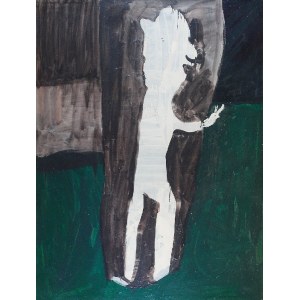
oil, tempera, canvas; 130.5 x 100.5 cm;
on reverse on canvas inscription:
PAINTING BY: / TERESA PĄGOWSKA / CONFIRMED: FILIP PĄGOWSKI / F. PĄGOWSKI.
The presented work, according to the message, dates from the 1960s. This may be indicated by the correlation with the work of Jean Dubuffet, a French painter and illustrator who independently, at the same time, adopted an analogous form for his works. The work probably came directly from the artist's studio, and is currently in a Polish private collection. Although, the painting is unsigned, it has a confirmation of authorship stamped on the back of the canvas by the artist's son, Filip Pągowski. In Teresa Pągowska's work, one searches in vain for a struggle with the matter of painting or painful traces of artistic intentions. Her paintings may be the conclusions of the painter's long deliberations on the final form or structure, as Boguslaw Deptuła mentions, writing: "There are paintings that are born in the course of the artist's fierce struggle with resistant matter and bear the stamp of the struggle. Burdened with layers of paint, with traces of corrections, sometimes even holes, they carry the burden of existence. Pągowska does not allow herself to do so. What can be seen is pure essence. Traces of the sublimation process are not revealed. They are left in it. When something finally appears on the canvas, it apparently irrevocably should have been there." The impulse for Teresa Pągowska to create is an experience, which she calls a reason. In an interview with Elżbieta Dzikowska, she says: "There is an experience that I call a reason. And since I have nothing of the reporter in me, I have to deepen this outline of experience in myself, live with it for a long time, so that it takes on flesh, so that it becomes a must. And immediately I look for a form. Because, after all, with us painters, everything is born from the eye and the head at the same time. The imagination sees and gives shape to the experience." In the offered painting, one can look for the "reason" mentioned by the artist, which is emphasized by the sparing form of the composition that prompts the viewer to contemplate the canvas and solve the puzzle - to find the "reason".







Recently viewed
Please log in to see lots list
Favourites
Please log in to see lots list