She studied at the Academy of Fine Arts in Cracow, first at the Faculty of Painting, in the studio of Prof. Jan Świderski, and then at the Faculty of Graphic Arts in the studios of Prof. Mieczysław Wejman - her future father-in-law - and Prof. Włodzimierz Kunz. In 1972 she completed her diploma - in graphic design under the supervision of Prof. Witold Skulicz and in lithography under Prof. Włodzimierz Kunz. She primarily practices metal techniques (etching, aquatint, splatter) and lithography. He also occasionally deals with art books.
In 1986, together with Eugeniusz Get Stankiewicz, she reactivated the STU Theater Gallery on Bracka Street in Cracow. One of the fruits of this activity was the creation of the so-called Gallery of Large Paintings, realized on 6 x 8 m canvases by many outstanding artists. These works were exhibited outdoors, in the urban space of Krakow's Krasinsky Avenue.
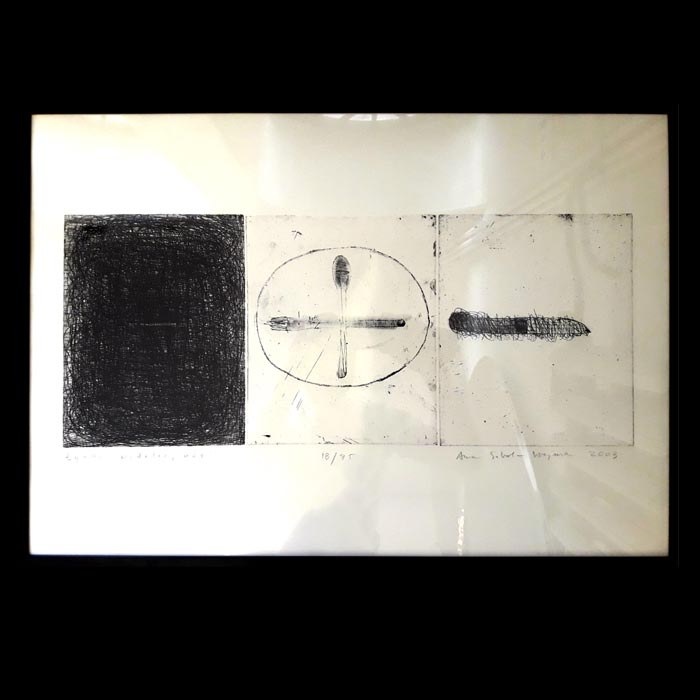
In fact, all of Anna Sobol-Wejman's work could be called by the title of one of her series - Diary of an Inner Life. Jan Fejkiel refers to these works with the words:
"The artist does not actually describe reality, but collects its material traces and shards of meaning. Thus, she avoids the didacticism and moralizing inevitably associated with history-making, storytelling, anecdotes. The works are devoid of traditional drama and its tensions. (...) The open space of printmaking allows a multi-threaded narrative, where the continuity of events is conventional, and history is naturally intertwined with the present, material fact with the record of thoughts, consciousness with the subconscious."
The artist's early works - with titles such as Inventory, Pieces of the Whole, Gazette, City, Everyday, Hours, Days and Years - were seen by critics as a look at the world from a distance, an attempt at a holistic metaphor (Krystyna Czerni). In subsequent engravings, the scale changed, as did the point of view - the "depicted world" was captured from a closer perspective, as if the lens of graphic vision was set to a macro function. The artist was increasingly preoccupied with the periphery of reality, its margins(Peripheries, 1996; Cloakroom, Storage Room).
She records the world with her own calligraphy - shaky, ephemerally entangling in the background and fading into it, then again tectonically blunt, primal in its own way(Museum, etching, aquatint, 2002), although only seemingly associated with childish awkwardness. Her succinct ideograms, simplified silhouettes, letters drawn as if with an awkward hand or mysterious signs are each time linked to the plastic matter of the environment, the texture of the background and the compositional structure. The artist often juxtaposes in a single work sequences of several, a dozen or even several hundred(OVA - Omnia Vincit Amor, 1996, etching, aquatint) modules, panels or metopes, developing into frieze-like, horizontal graphic stories; less often - vertical "review boards", tableaux serving to penetrate into semi-secret knowledge, anchored in the author's existential experiences.
She spins a tale about herself and her own art, pulling threads from works already created to new ones, in which she applies familiar, though compositionally processed, motifs.
"I never start completely from scratch. It's kind of a chain: I always have a starting point, which is in the previous work. I make something complex, one of the fragments occupies me and pulls me further. I've noticed that this is how I function. Sometimes even in the next print I like to change something, give a sudden color, move some tile."
Significant and important in her work seems to be the series of etchings The Shirt of Bécherel (2001). At its genesis was a find in one of the antique shops in Brittany, where Anna Sobol-Wejman came across a long women's shirt made of canvas with coarsely woven weaves, with an elongated, neatly hemmed crack in the place of sex. Embroidered around it was the inscription "Dieu le veut" (God willing). The encounter with this visually and existentially marked, material trace of someone's fate provoked the artist to make an evocative statement. On the etchings, in an intricate and concise manner at the same time, she showed a highly personal reading of the stigma of someone else's intimacy, a metaphor for a woman's destiny - its drama and the peculiarity ascribed only to it.
Perhaps this very work initiated a whole series of prints evoking an elegiac and melancholic tone. Sobol-Wejman explicitly called one of her series Melancholia (2002). This notion and the associated state of mind or mental system, also found in many works outside the series, is expressed by the artist through a landscape with a lonely boat(Diary of an Inner Life II, 2004), a composition with splinters of panels visualizing irretrievably irreversible events, incompatible fractions of objects and views, fragments of rebuses that are no longer possible to solve, escaping beyond the edges of the composition.
If it is impossible to deny Anna Sobol-Wejman's works expression, it is an expression unencumbered by pathos, and therefore in the service not of violent emotional turns, but rather of graphic records of memory, made with self-consciousness of workshop skills.
Since 1991, the artist has been working steadily with Jan Fejkiel Gallery in Krakow, where she has held five solo exhibitions until 2009. Other solo shows of Anna Sobol-Wejman's works took place in Reykjavik, Toyama, Tokyo, Zwolle in the Netherlands, Amsterdam, Storrs (Connecticut), Gyor in Hungary, Saint-Herblain in France, Minneapolis, Nuremberg, Bielefeld, as well as in Krakow, Poznan and Warsaw, among others.
In 1995, she won the Grand Prix of "The Masters of Graphic Art" at the Third International Biennial of Graphic Art in Gyor, while in 2009 she won the Witold Wojtkiewicz Prize awarded by the Union of Polish Artists - Cracow District. She has participated in many other group exhibitions and cyclical competition events of international rank, including the International Print Biennale (Triennale) in Cracow (1976-2000), International Print Biennale in Ljubljana (1995), International Print Biennial in Seoul (2002, 2004), Biennale Internationale de la Graveure et des Nouvelles Images in Sarcelles (France; 2003).
The artist's works are in the collections of the National Library in Warsaw; Graphishe Sammlung Albertina in Vienna; Museum of Modern Art in New York; National Gallery of Art in Washington, DC; Janos Xantus Museum in Gyor, Hungary; William Benton Museum of Art in Storrs, USA; Minneapolis Institute of Art; Musée des Beaux Arts in Chambéry, France, as well as in private collections in Denmark, France, the Netherlands, Iceland, Japan, Germany, the USA and Poland.
Knowledge of Anna Sobol-Wejman's work is brought to us primarily by the catalogs of her solo exhibitions held at Jan Fejkiel Gallery (1995-2009), as well as "Anna Sobol-Wejman. Tide and Tide" (exhibition catalog, Pryzmat Gallery, ZPAP Krakow District, Krakow 2009) and "Anna Sobol-Wejman. Memento Vitae, prints 1996-2002" (exhibition catalog, Kulturzentrum im Krakauer Haus, Nuremberg, Jan Fejkiel Gallery, Krakow).