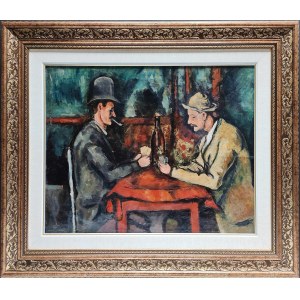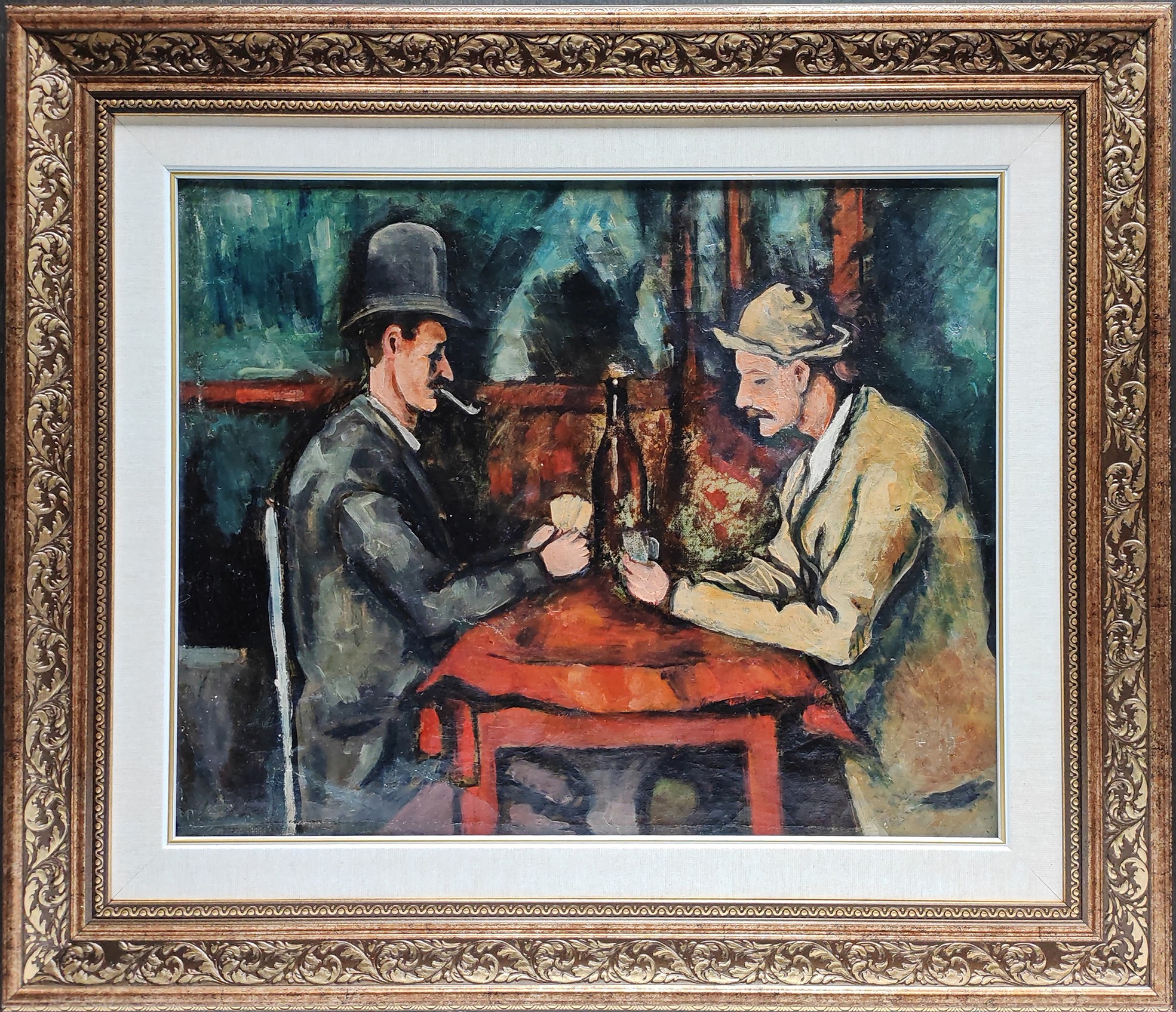
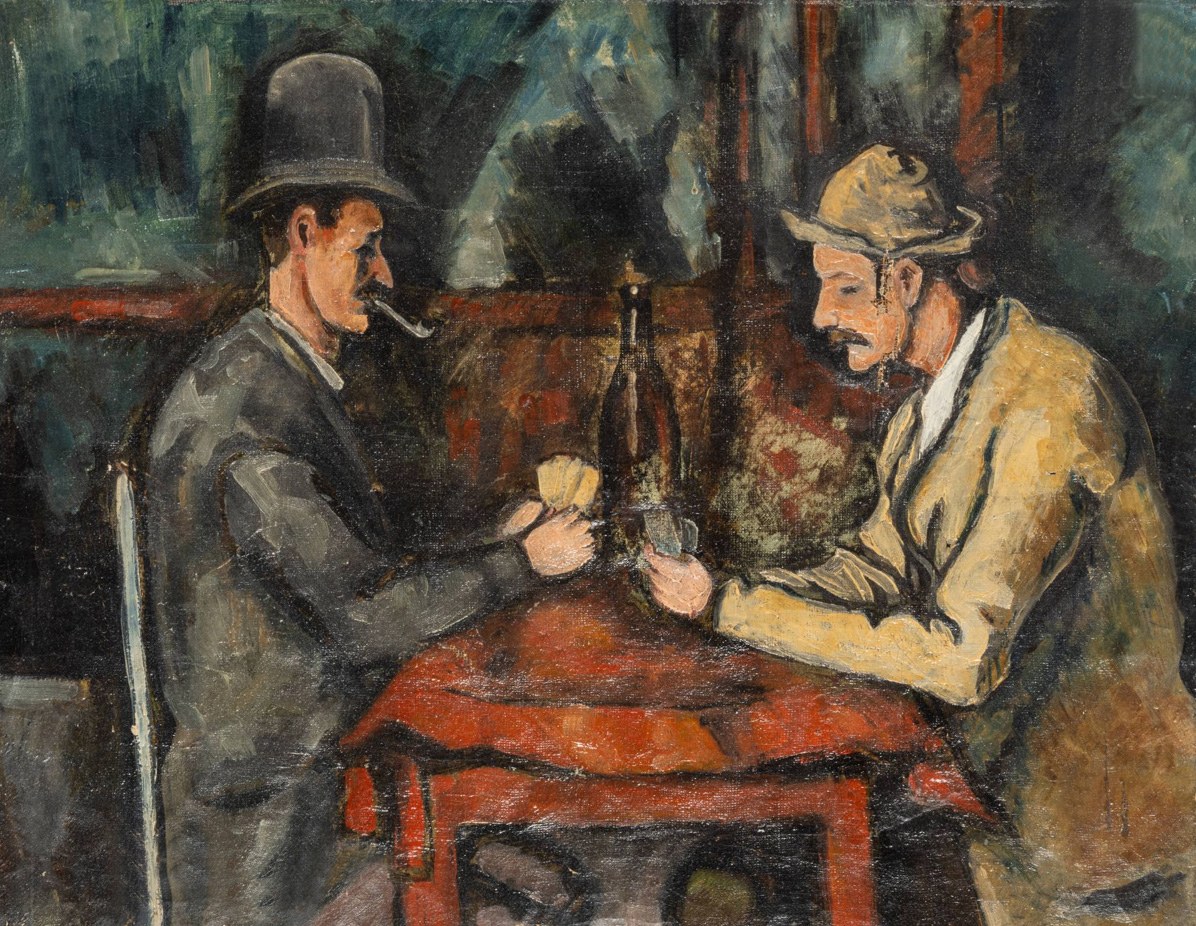
Paul Cézanne (1839-1906), Playing cards, copy 1st half of 20th century.
Technique: Oil on canvas
Dimensions: approx. 39 x 31 cm, 47 x 55 cm (with frame)
State of preservation: Canvas after conservation, losses of the paint layer were supplemented.
On the back numerous reinforcing patches (spot duplication) and handwritten inventory or auction number "1633".
The condition of the canvas suggests a rich history of the object.
The work is a former copy of one of the most groundbreaking compositions in the history of modern art. In Playing Cards, Cézanne moved away from anecdotal depictions of genre scenes to monumentalization of figures and analysis of form.
The copy on display was executed with great painterly freedom. Although it deviates from the original, it captures well the weight of the composition and the color palette (ochres, blues, deep browns) characteristic of Post-Impressionism. The numerous repairs visible on the back prove that the painting was treated as a valuable part of the collection for decades.
Paul Cézanne is a French painter whose work bridged the gap between 19th-century Impressionism and modern trends of the 20th century. Called the "father of modern art," he rejected the transience of light in favor of seeking permanent structures and geometric forms in nature. He painted in a slow and analytical manner, building compositions from rhythmic brushstrokes. His series Playing Cards is one of the most important achievements of Post-Impressionism, in which the author monumentalized the everyday genre scene.