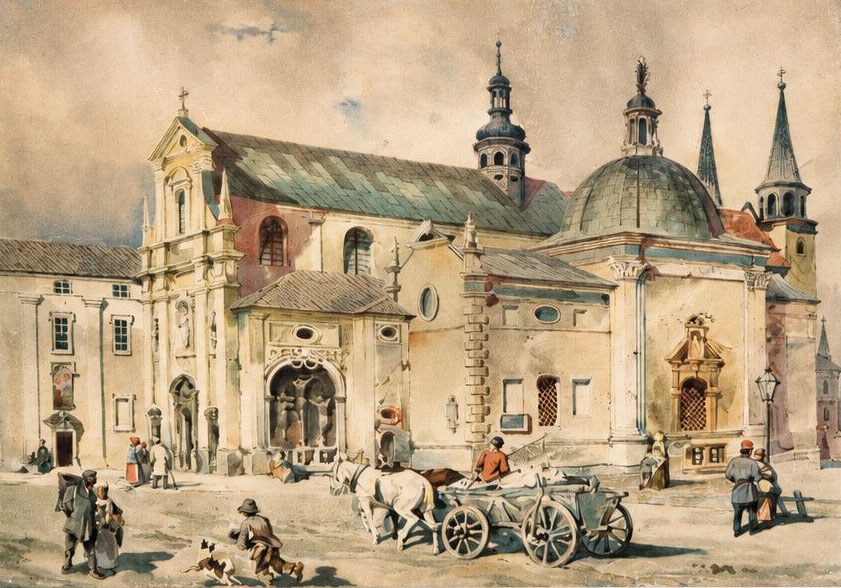
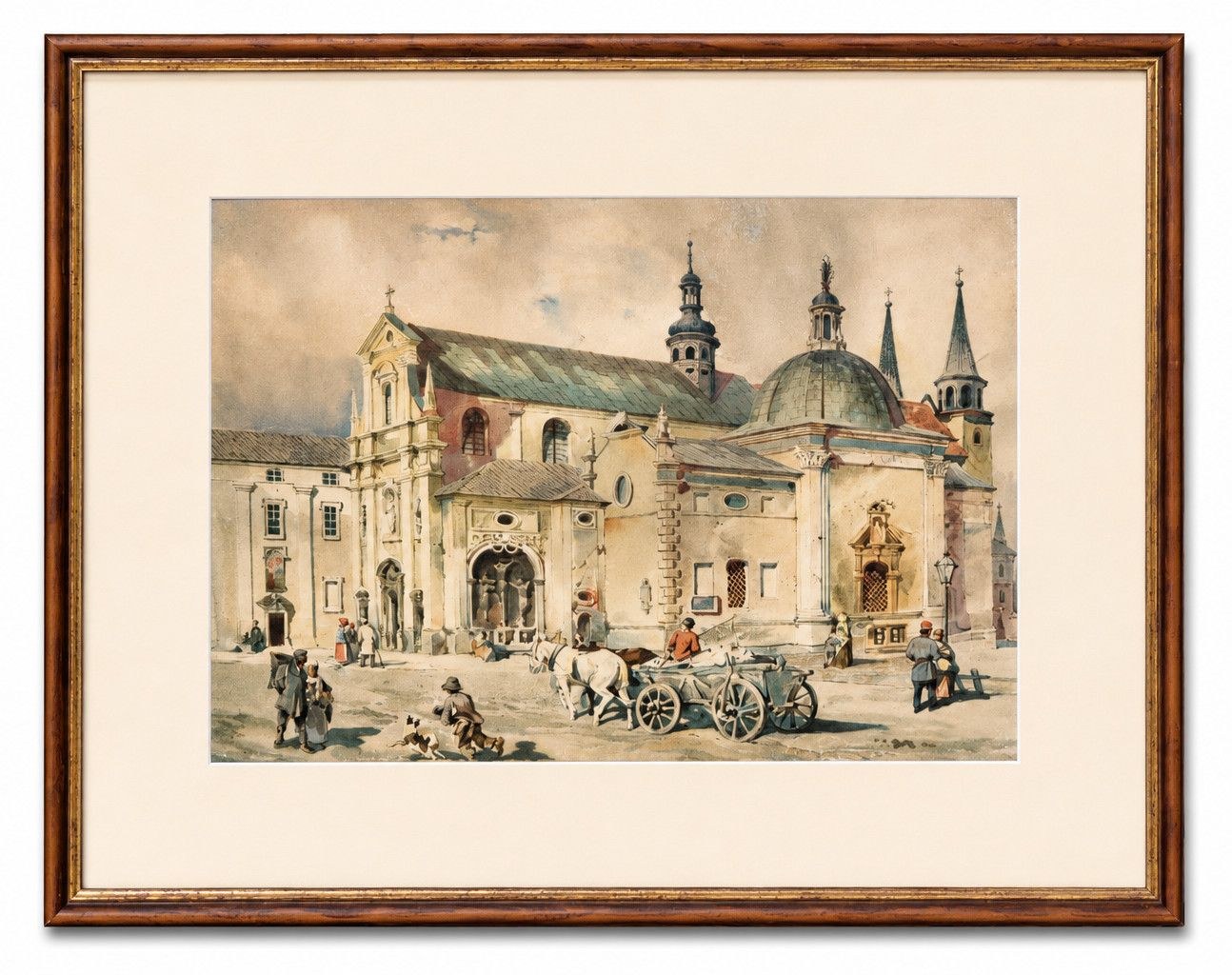
Chromolithograph on paper, signed lower left
From the portfolio: "Jewels of the City of Kraków," 1886
Dimensions in frame: 33.5 x 41.5 cm (21 x 29 cm)
Stanisław Tondos (Kraków 1854–1917 Kraków) – Polish landscape painter. He studied from 1869 to 1875 at the School of Fine Arts under the guidance of Jan Matejko and Władysław Łuszczkiewicz, and continued his studies in Vienna and Munich. The artist primarily painted watercolors depicting cityscapes (vedute), though he also worked in oils and pastels. He most frequently depicted Kraków, but also painted Warsaw, Poznań, and Lviv, and traveled to Venice, Vienna, Nuremberg, and Magdeburg to work. His works have documentary value today, as they illustrate the appearance of buildings and entire architectural complexes that no longer exist. Stanisław Tondos was an advocate of promoting art through postcards; his works were popularized in this form by the publishing house Salon Malarzy Polskich. In 1886, in collaboration with Juliusz Kossak, he published a portfolio of prints titled *The Jewels of the City of Kraków*, containing reproductions of 24 watercolors. Later, together with Wojciech Kossak, he published further series of watercolors: St. Mary’s Church in Kraków (1892), Wawel: Treasure Trove of the Past, Seat of the Piasts and Jagiellons (1910), and Kraków Legions (1915–1917). In Kraków, he exhibited at the Society of Friends of the Fine Arts, and in Warsaw, at the Zachęta Society and the Krywult Salon. He received gold medals at postcard exhibitions in Warsaw and Paris in 1900, and he also served as artistic director of the magazine *Świat*.
Juliusz Kossak (Nowy Wiśnicz 1824 – 1899 Kraków) – Polish painter, draftsman, and illustrator. He specialized in historical and battle scenes; horses were a favorite subject of his paintings. He painted small-format works, primarily in watercolor. He was one of the initiators of the establishment of the National Museum in Kraków. Father of Wojciech Kossak. Initially—from around 1842—he studied at the law faculty of the University of Lviv, while also studying drawing under Jan Maszkowski. From 1850 to 1852, he lived alternately in Lviv and Warsaw. In 1852, he left for Vienna, where he studied for a short time in Ferdinand G. Waldmüller’s studio; he also visited Hungary. At the turn of 1852–53, he visited Paris for the first time; he settled there for several years beginning in 1855. In 1860, he returned to Warsaw. In 1869, he studied in Franz Adam’s studio in Munich and remained in close contact with J. Brandt. In the fall of 1869, he settled permanently in Kraków, from which he rarely traveled—he undertook an artistic journey through Eastern Galicia and spent the turn of 1872–73 in Munich. He exhibited his works in Lviv, Kraków, Warsaw (at the TZSP and the Krywult Salon), Łódź, Poznań, and abroad: in Paris, Munich, Dresden, Berlin, and Vienna. The most important motif in the artist’s paintings was the horse, depicted in historical scenes, battle scenes showing military marches, as well as genre scenes—hunts, rides, and races. He also painted—especially after his studies in Paris and Munich—scenes from the everyday lives of ordinary people and equestrian portraits. His favorite medium was watercolor, which allowed him to quickly capture the movement and form of the unfolding scene.